Getting started#
First import the module
import opsimsummaryv2 as opsim
Then load an OpSim output database using the OpSimSurvey class:
OpSimSurv = opsim.OpSimSurvey('baseline_v3.4_10yrs.db')
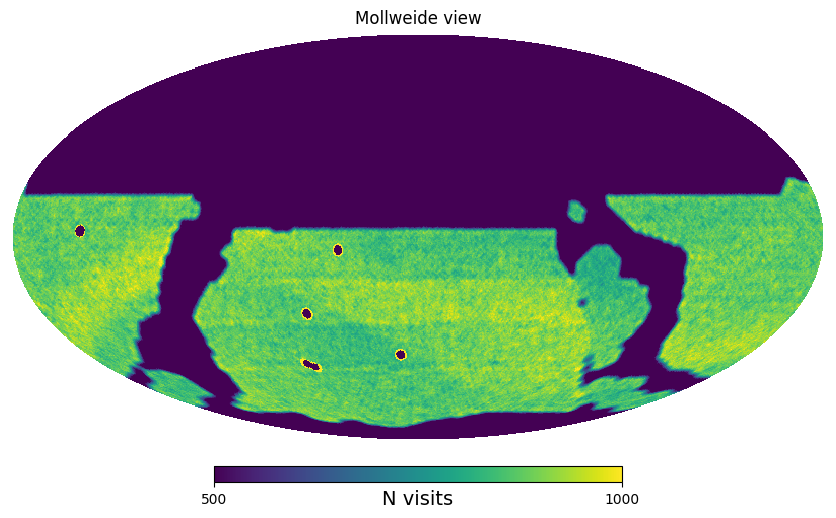
Compute healpy representation of the survey:
# Compute the healpy representation of the survey
# with a cut to a minimum of 500 and a maximum of 10000 visits
OpSimSurv.compute_hp_rep(nside=256, minVisits=500, maxVisits=10000)

# Plot the healpy configuration
fig = OpSimSurv.plot_hp_rep(min=500, max=1000)
You can get the observations at any RA, Dec corrdinates using:
Obs = OpSimSurv.get_obs_from_coords(ra, dec, is_deg=False)
Note that Obs is a generator. One can obtain the list of observations by doing Obs = list(Obs).
Writting a SIMLIB file#
To write a SIMLIB you need to sample the survey:
# Sample the survey
N_fields = 50000
seed = 1234

# Sample the suvey with 100 fields
OpSimSurv.sample_survey(N_fields, random_seed=seed)
Warning
An insufisant sampling will lead to a bad representaiton of the LSST survey. The default value used in the make_simlib.py script is N_fields=50000
Then the SIMLIB can be write using the SNANA_Simlib class:
# Writing simlib
sim = op.sim_io.SNANA_Simlib(OpSimSurv, out_path='./example_files/')
sim.write_SIMLIB()
The make_simlib.py script available on the github repository is meant to help to create the LSST SNANA SIMLIB. It could be simply used:
$ python ../script/make_simlib.py -h

usage: OpSimSummaryV2 script [-h] [--Nfields NFIELDS] [--host_file HOST_FILE] [--author AUTHOR] [--hf_RA_col HF_RA_COL] [--hf_DEC_col HF_DEC_COL]
                            [--hf_radec_unit HF_RADEC_UNIT] [--min_MJD MIN_MJD] [--max_MJD MAX_MJD] [--min_visits MIN_VISITS]
                            [--max_visits MAX_VISITS] [--output_dir OUTPUT_DIR] [--random_seed RANDOM_SEED]
                            [--limit_numpy_threads LIMIT_NUMPY_THREADS] [--n_cpu N_CPU] [--snana_wgtmap SNANA_WGTMAP]
                            db_file

Execute OpSimSummaryV2 to create a SIMLIB from a OpSim output database.

positional arguments:
db_file               absolute path to the opsim database.

options:
-h, --help            show this help message and exit
--Nfields NFIELDS, -Nf NFIELDS
                        Number of fields to sample
--host_file HOST_FILE, -hf HOST_FILE
                        absolute path to a host file.
--author AUTHOR, -auth AUTHOR
                        Author of the file.
--hf_RA_col HF_RA_COL, -hfra HF_RA_COL
                        RA column keys in host file
--hf_DEC_col HF_DEC_COL, -hfdec HF_DEC_COL
                        DEC column keys in host file
--hf_radec_unit HF_RADEC_UNIT
                        DEC column keys in host file
--min_MJD MIN_MJD     Minimum date to query
--max_MJD MAX_MJD     Maximum date to query
--min_visits MIN_VISITS
                        Minimum observation visits
--max_visits MAX_VISITS
                        Maximum observation visits
--output_dir OUTPUT_DIR
                        Output dir or file for the SIMLIB
--random_seed RANDOM_SEED, -rs RANDOM_SEED
                        Random seed for survey sampling
--limit_numpy_threads LIMIT_NUMPY_THREADS, -np_threads LIMIT_NUMPY_THREADS
                        Limit the number of threads numpy could use.
--n_cpu N_CPU         Number of cpu to use for matching survey and hosts.
--snana_wgtmap SNANA_WGTMAP
                        SNANA WGTMAP to apply to host.